
Heat Pumps and District Heating in Focus at International Conference in Lund

On September 9–10, more than one hundred participants from across Europe gathered in Lund for an international conference, Study Tour to Lund – Sustainable Heating & Cooling in Practice: Insights on District Heating, Waste Heat, Policy, and Digitalisation, focused on heat pumps and district heating.
The event was organized by SweHeat, the Swedish Energy Agency, Sustainable Heating & Cooling by Sweden (SHC by Sweden), and Business Sweden. The program included presentations, discussions, and site visits to facilities such as E.ON’s Ectogrid, Kraftringen’s plant in Brunnshög, and Alfa Laval.
There was strong interest in how Sweden uses district heating and heat pumps as part of the energy transition. Swedish experiences were at the center of the discussions, while international participants contributed perspectives, comparisons, and examples from their own countries.
Swedish Perspectives and International Comparisons
One of the presentations was delivered by Simon Bolteau from EKA. He demonstrated how heat pumps can create value both locally and at large scale – from heat recovery in sports facilities to large-scale heat production in district heating networks.
As an international example, the project in the city of Salaspils, Latvia, was highlighted. There, a data center is being built adjacent to the district heating plant, allowing waste heat from the data center’s cooling system to be recovered and used as a heat source. In parallel, an air-to-water heat pump using natural refrigerants is planned for installation directly next to the facility.
The strategy is to diversify heat production, increase electrification, and at the same time maintain a fuel-based backup solution for periods of high electricity prices. EKA is involved as an independent consultant throughout the entire process, from technology selection and procurement to implementation and performance evaluation during the warranty period.
The project has been underway for some time, and the procurement process was initiated in recent days.
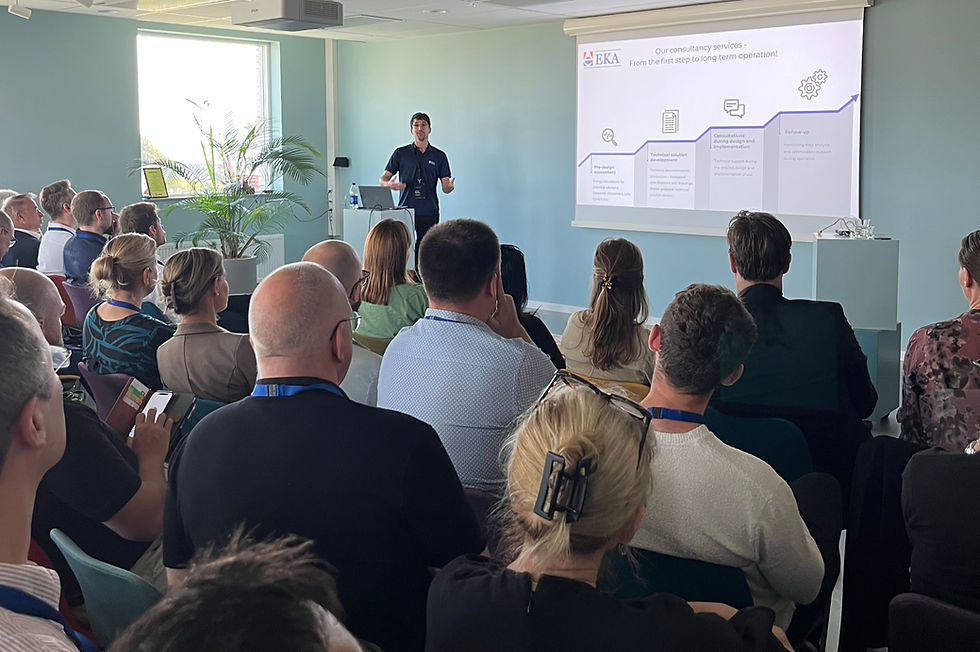
Bolteau emphasized—echoing the views expressed by the CEO of Salaspils Siltums—that the combination of electrification, a diversified heat production portfolio, and the use of natural refrigerants reflects a direction that is also shaping the development of the Swedish market.
Benefits of Heat Pumps
Compared with combustion-based boilers, heat pumps can reduce both energy consumption and emissions while supporting electrification and enabling more flexible and resilient energy systems for the future. |
Sweden’s Electrification Strategy and Flexibility Potential
In Sweden, similar issues are receiving significant attention. In its report The Electrified Society of the Future¹, the Swedish Energy Agency highlights the potential of district heating systems as a flexibility resource for the power grid—both by helping to balance electricity demand and by making use of surplus electricity when it is available.
A key conclusion of the report states:
“The use of large-scale heat pumps and electric boilers in district heating networks, combined with thermal energy storage, has significant potential to utilize surplus energy and serve as an upward balancing resource for the power system.”
Interest in large-scale heat pumps and electric boilers is growing, often in combination with thermal energy storage. The goal is to replace older fossil-fuel-based units while building more robust and flexible energy systems. Natural refrigerants are becoming an integral part of this transition.
This approach aligns closely with the direction of the Swedish market and is reflected in examples from Latvia, where electrification, diversified heat production, and backup capacity are being developed in parallel to create resilient and future-proof district heating systems.
¹ Swedish Energy Agency (ER 2021:28), The Electrified Society of the Future – Analysis for Sustainable Electrification.
Examples – From Local Heat Recovery to Large-Scale District Heating Networks
The following case studies and projects have been carried out by EKA.
Söderhamn: Local Heat Recovery from an Ice Rink and Bandy Arena – Waste heat is recovered and used to heat a sports hall, swimming pool, and tennis hall. The system combines cooling and heating, providing approximately 1.15 MW of cooling and 1.5 MW of heating capacity.
Backavallen, Katrineholm: Multi-Facility Sports Complex – Two refrigeration plants with a total cooling capacity of 1.3 MW, including heat recovery, complemented by several decentralized heat pumps, a geothermal energy storage system, and solar panels.
Algutsboda, Emmaboda: Small Municipality Seeking to Reduce Dependence on Pellets – A feasibility study on ground-source and air-source heat pumps with a capacity of 200 kW and a supply temperature of +80°C. The project illustrates a growing trend of diversifying away from pellet-based heating due to price volatility.
Salaspils, Latvia: Large District Heating Plant – Produces approximately 60,000 MWh of heat annually. New investments include an air-to-water heat pump (1.2 MW) and data center waste heat recovery (2.6 MW), adding a total of approximately 3.8 MW of new heating capacity.
Riga, Latvia: Feasibility Study at a Water Treatment Plant – Planned heat pump installations with capacities of up to 15 MW.
Swedish Municipality (Ongoing): Heat Recovery from Water Treatment and District Cooling – A feasibility study for a 15 MW heat pump combined with a 2 MW district cooling system supplying a local hospital.
Would you like to evaluate the potential of heat pumps in your district heating system?
Together, these examples demonstrate how heat pumps can create value at multiple scales—from local sports facilities to entire cities. Regardless of scale, the trend is clear: electrification, diversification of heat production sources, and the adoption of natural refrigerants are strengthening both sustainability and energy security.
This is particularly evident in smaller municipalities and local district heating networks, where EKA is seeing growing demand for feasibility studies evaluating heat pumps as an alternative to biofuels such as pellets, whose costs have become increasingly uncertain. In this context, heat pump technology is emerging as a way to enhance both economic resilience and long-term energy security.
Regulation and Investment Climate
In Sweden, district heating operates under a free-pricing model, allowing district heating companies to adjust their tariffs in line with changing costs. At the same time, initiatives such as the Price Dialogue (Prisdialogen) aim to promote transparency and build trust with customers. This framework gives Swedish district heating companies greater opportunities to justify investments in technologies such as heat pumps.
In the Baltic countries, and particularly in Lithuania, district heating prices are more heavily regulated by the government. During the conference, representatives from Lithuania highlighted that it can be challenging to invest in large-scale heat pumps when electricity costs are uncertain and revenues are constrained by regulated tariffs. Without guaranteed returns, such investments can quickly become financially risky. These differences in regulatory frameworks help explain why Swedish utilities often find it easier to move forward with electrification projects, while district heating companies in the Baltics must navigate a more tightly regulated environment.
The conference in Lund demonstrated how Swedish experiences can inspire international stakeholders and how knowledge exchange can accelerate the pace of electrification. With Swedish examples as a reference point and parallels from countries such as Latvia, the message was clear: heat pumps and natural refrigerants will play a central role in the energy transition, and collaboration between stakeholders will be essential for taking the next steps forward.


Comments